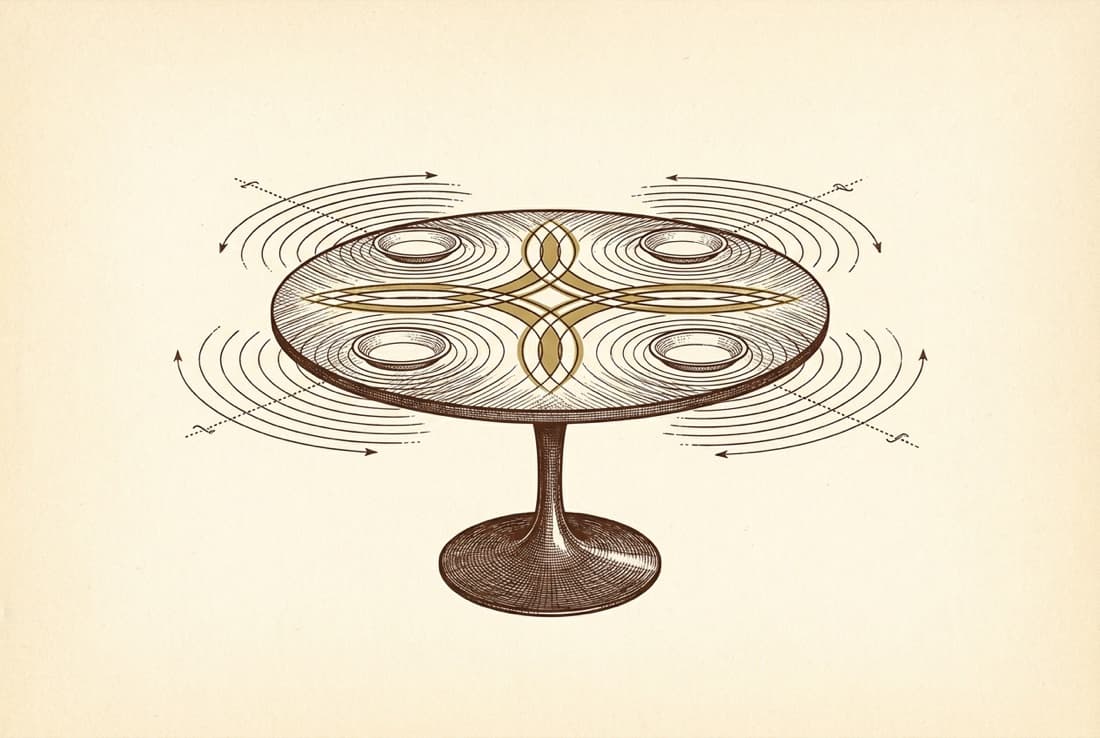
The Object
A four-person table with a tulip-shaped base. Mid-century, Eero Saarinen lineage. Sitting at it, each person faces a dish placed directly opposite. The dish is the heart of the system.
The Dish
The dish is both microphone and speaker. It catches your voice as you speak and projects everyone else's voice back to you. The acoustic playing field is leveled: the loud and the quiet arrive equalized; proximity stops mattering. The table itself is the instrument.
Inside the dish, visual indicators glow. They show how long each person has talked, relative to the others. Your own is visible at a glance. So is everyone else's. The board is always public and always accurate.
The Time Economy
Each person has an allotted speaking time. Time is the currency of the table.
If others want to hear you continue, they can forfeit their own time to extend yours. Generosity is built into the economy. Speakers the table values get more runway, given freely.
At any point, anyone can press the retort button. The current speaker must finish the thought they're on, then yield. The retort works like an interruption with a brake. You don't talk over each other, but you also don't have to wait passively until the speaker decides they're done.
The Penalty
If you keep going after the meter calls time, or fail to yield after a retort, you're penalized two-to-one on your next allotment. Speak one minute over now; lose two minutes later.
The penalty isn't punishment. It's a price. You can choose to pay it. If what you have to say is worth burning two minutes of future air-time for one minute now, the system supports that decision.
It just makes you decide.
What It Argues
This is a commentary on interrupters, mansplainers, and conversation hogs. The people who routinely take up most of the room's air without noticing they're doing it. The "quiet ones" already live inside this asymmetry. They experience it daily, often for far longer stretches than any single dinner conversation, and usually with worse consequences: overlooked at work, dismissed in family settings, talked over in groups.
The Talking Table doesn't punish anyone. It just makes the data visible. Every minute of dominance shows up on the dish. Every interruption gets logged. The frustration the loud types feel from the system pushing back is small, and proportional, and informative. A tiny fraction of what their interlocutors absorb in normal life.
The hope: empathy or introspection by way of measurement. Scientific data they can hold against themselves, in their own dish, at their own seat.
The system doesn't change anyone. It just makes the imbalance impossible to deny.
A Level Playing Field
The table is also a response to cultural and structural conversational asymmetry. People from different backgrounds, cultures, and communication styles get steamrolled in mixed groups by the dominant style of the room. The quieter speaker isn't lacking ideas. They're losing the floor to the louder one before they get to put the ideas down. The Talking Table flattens that by giving every seat the same allotment, the same visibility, and the same enforcement.
It is, in that sense, a fairness device. Not corrective at the individual level. Corrective at the structural level. Every voice gets the same airtime, regardless of confidence, accent, vocabulary, or volume.
And A Note on Political Debates
The same mechanism applies, painfully, to formal political debates. Speakers routinely talk past their allotted time after being told it's up. The moderator's "your time is up" is a verbal request that the speaker is free to ignore, and they almost always do. The penalty is reputational, eventually. But the on-air reality is whoever is willing to keep speaking, gets to keep speaking.
A version of the Talking Table, scaled to a debate stage, would convert the moderator's social request into a structural one: ignore the time cap and you spend twice as much of your next round to recover it. Suddenly the calculus shifts. Going over isn't free anymore.
Status
Concept.