The Object
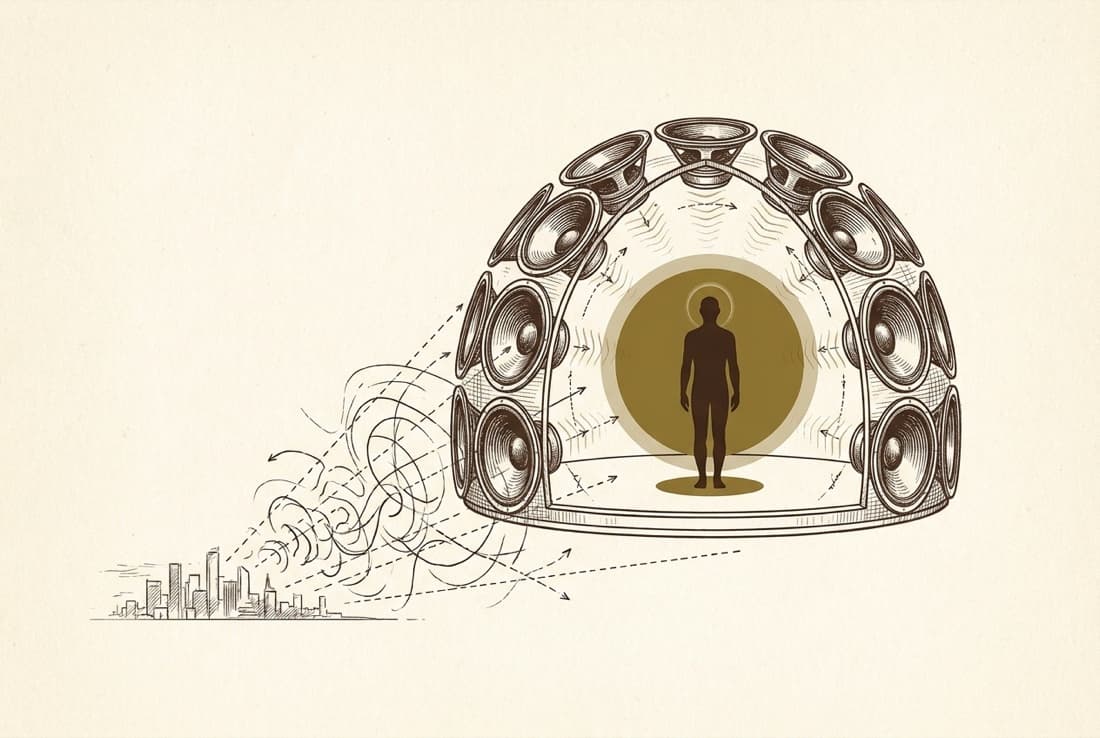
A small igloo. A dome large enough for a person to stand inside. Built from an array of speakers. The trick: every speaker is wired in reverse. Speakers and microphones are the same transducer in mirror image; flip the wiring and the cone that pushes air becomes a cone that reads it. The igloo is, electrically, a cluster of microphones disguised as speakers.
How It Works
Place the igloo somewhere loud. New York City is ideal. Outside the dome, the ambient soundscape hammers it from every direction. Each transducer converts a small portion of that sound pressure into electrical signal. The signals are summed, rectified, and fed into a capacitor.
Two things happen at once:
- Energy is extracted. The sound that hits the dome is converted, partially, into stored charge. That energy doesn't make it into the interior space.
- Sound is dampened. Because the transducers are absorbing rather than reflecting, the inside of the igloo is meaningfully quieter than the outside.
When the capacitor reaches a threshold, it discharges through a small mechanism. A striker, a solenoid, a tuning fork. And rings a single soft bell inside the dome.
What You Hear Inside
Standing inside, you hear the city muted. The dome is doing acoustic work. And every so often. When enough sound has been swallowed and converted. The bell rings. A small, pleasant tone earned by the city's noise.
The Commentary
Sound pollution is the pollutant we don't address. We've built whole legal frameworks around what we put in the air, the water, the food. Smells, when they're bad enough, are regulated. Taste, when it's poisonous, is regulated. But noise. Eighty, ninety decibels, sustained, layered, inescapable. Is permitted as ambient infrastructure.
People who live with misophonia, or hyperacusis, or any heightened auditory sensitivity, know what it costs. It costs sleep, attention, relationship, work. It is a real and unaccounted-for tax on a real subset of people.
The igloo doesn't solve any of that. But it suggests that the problem is physical. Sound is energy, energy can be moved, the room can be made quieter by a structure that takes the noise away rather than reflecting or absorbing it passively.
The Honest Math
Sound is energy, but it is humble energy, and the entry says so. A loud street at eighty or ninety decibels carries on the order of a ten-thousandth of a watt per square meter. A dome's worth of transducers, even harvesting generously, banks fractions of a milliwatt. The honest consequence: the bell does not ring often. Depending on the threshold, the city might take an hour, an afternoon, a day to earn one chime.
That scarcity turned out to be the piece. If the bell rang constantly it would be a noise machine. Because it rings rarely, each chime is a receipt: that much of the city, swallowed and retired. The quiet you feel inside comes mostly from the physical mass and absorption of a hundred cones aimed the wrong way; the harvesting is real but ceremonial. Both facts stay in the writeup, because pretending the dome runs on noise would be its own kind of noise.
The Components
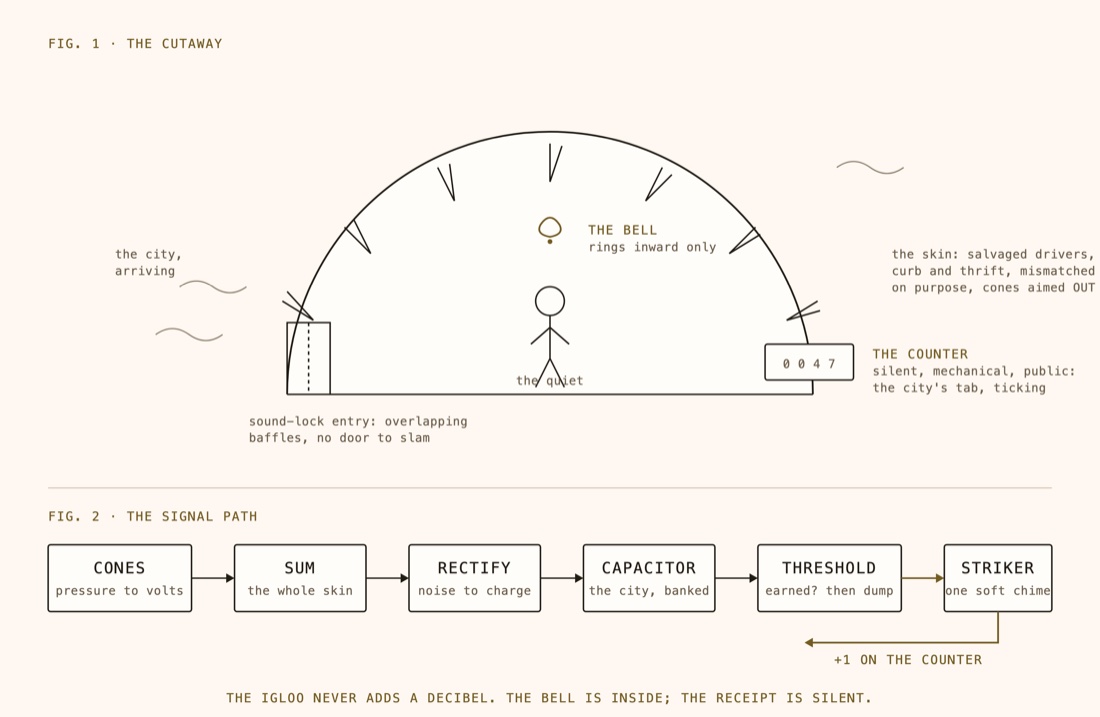
- The frame. Geodesic, because domes love compression and hate resonance.
- The skin. Salvaged speakers, curb finds and thrift bins, mismatched on purpose. The Couch Bison ethic: the material was already thrown away, and a wall of orphaned drivers looks like what it is, a choir of discarded mouths put to work as ears.
- The electricals. Summing bus across the skin, rectifier bank, one fat capacitor, a threshold trigger, a solenoid striker, one good brass bell. No amplifier anywhere in the building, on principle.
- The entry. A sound-lock: overlapping baffles you walk through, like a darkroom's light trap. No door, because a door can slam, and a slam would be the igloo failing its one job at its own threshold.
- The counter. Outside, facing the street: a silent mechanical tally that ticks once per chime. The public-facing receipt.
The Rules It Lives By
Decisions made, open to veto:
- The bell is the only voice. No playback, ever. A refuge that replays the city it swallowed betrays itself. (A separate confessor variant, whispering the day back at midnight, stays in the drawer as its own piece.)
- The igloo never adds a decibel. The bell rings inward only. The street gets the counter, not a chime, because an instrument against noise pollution does not get to pollute.
- Built for the corner, born in the gallery. The prototype proves itself indoors with the city piped in; the real test is a loud intersection and a permit.
Why I Want To Build It
Personal. I have some misophonia. It affects my life. The igloo is what my nervous system would build itself if it could.
Status
Concept, spec'd to the component level. The physics is stated honestly, the rules are written, and the sourcing is the practice: every curb-side speaker from here on is a candidate for the choir.