The Idea
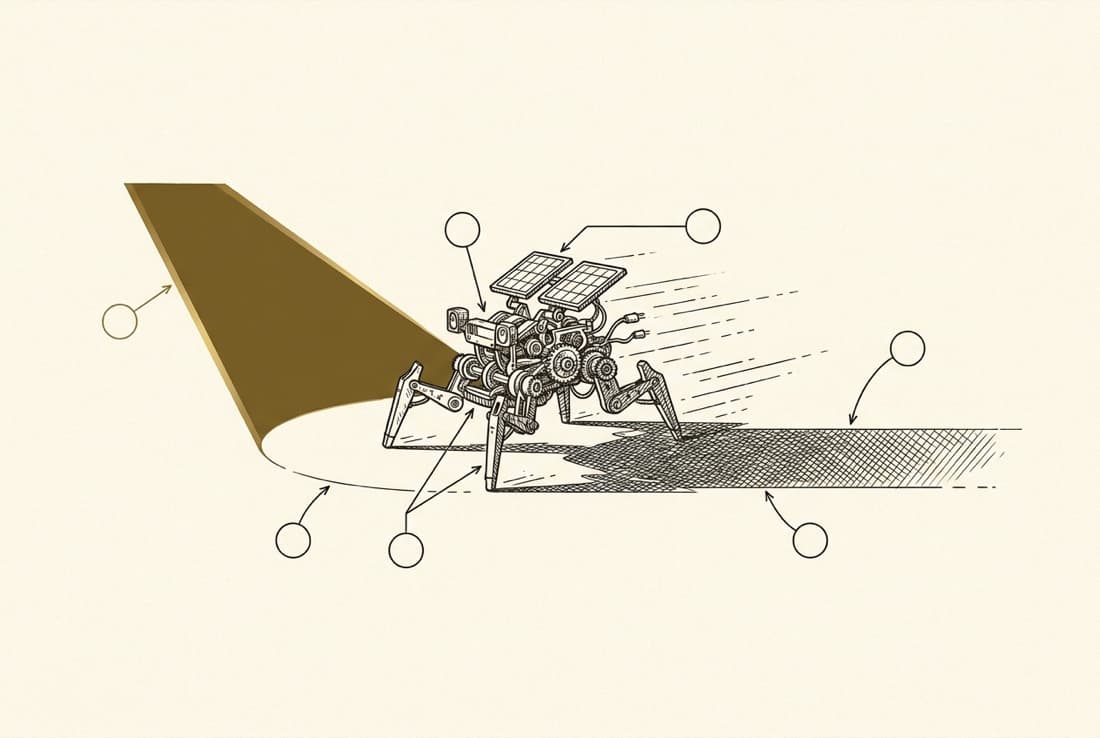
The machine has solar cells. Light powers it. But its single behavioral instinct is to flee the light. Fast as it can, toward the nearest shadow. The moment it reaches darkness, it stops. There, it rests, powered down, at peace.
Then the sun moves. The shadow moves. Light reaches it again. It wakes. And runs.
The Loop
Peace requires darkness. Darkness denies it power. Power triggers panic. Panic produces motion. Motion eventually finds shade. Shade restores peace. The sun keeps moving. The cycle never resolves.
It cannot ever quite settle. That's the piece.
What It Echoes
Crickets in a basement when you flick the light on. Cockroaches under a fridge. BEAM robotics. Theo Jansen kinetics. But with an emotional/behavioral charge: the creature is uncomfortable with its own power source.
The Room
The real version is not one machine. It is a dark gallery room and fifty to a hundred of them, resting on the floor in total stillness. Visitors get a flashlight at the door.
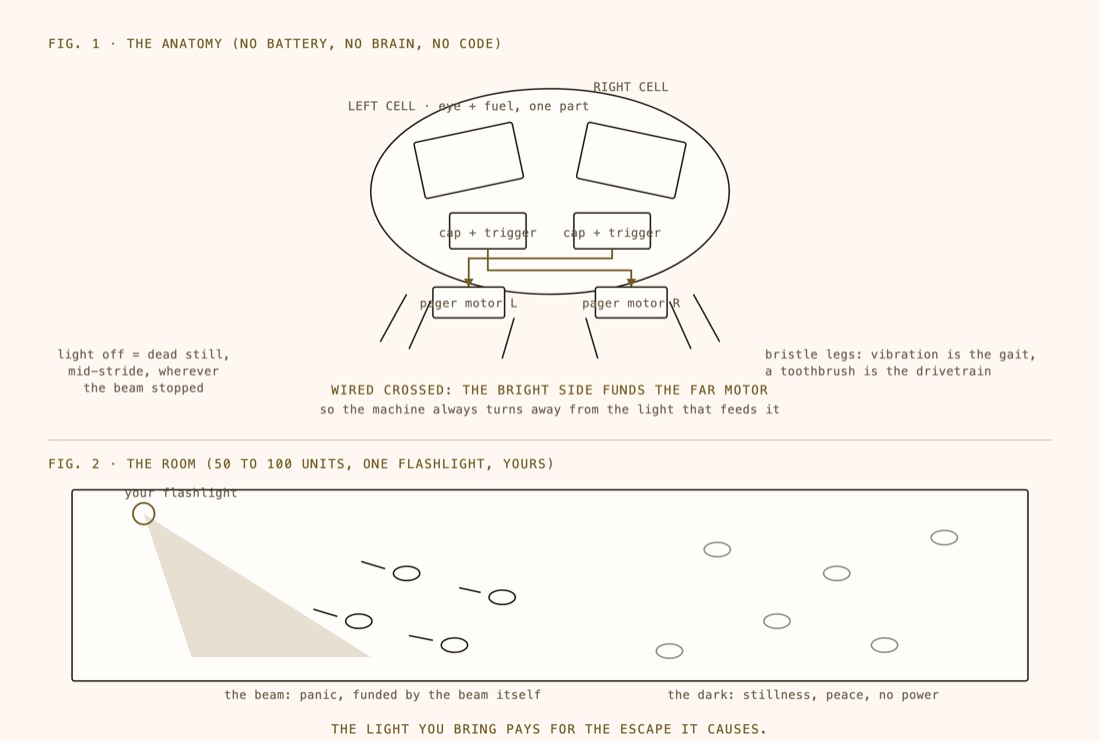
Shine it at the floor and the patch you light up scrambles. Like roaches when the kitchen light snaps on. Sweep the beam and a wave of panic follows it across the room. Hold it on one machine and it runs until it finds the dark beyond your cone, where it dies mid-stride and is at peace again.
That is all it does. That is the whole piece. The visitor walks in holding the sun, and every use of it is a small act of cruelty they cannot resist committing, funded entirely by the light they brought.
The Anatomy
The build is deliberately brainless. No battery, no microcontroller, no code:
- Two small solar cells, angled left and right. Each cell is simultaneously the eye and the fuel line: there is no separate sensor, because the power source IS the perception.
- Two capacitor-and-trigger circuits (classic solar-engine style): charge until threshold, then dump.
- Wired crossed. The left cell's dump drives the right motor and vice versa, so the machine always pivots away from whichever side is brighter. Fear, implemented in copper.
- Pager motors and bristle legs. Vibration is the gait; a toothbrush head is the drivetrain. Crude, fast-looking, cheap.
- Darkness is death and peace at once. No light, no charge, no motion. It stops wherever the beam stopped touching it.
Per-unit cost lands around five to eight dollars in parts, which is the whole point: the swarm is the piece, and the swarm has to be affordable. A hundred units is a few hundred dollars of electronics and a lot of hot glue.
Status
Concept, now spec'd to the component level. The single-unit prototype is a weekend: two cells, two caps, two pager motors, one toothbrush. The room needs a gallery, a dimmer, and a box of flashlights by the door.